
 Parallels of the living
Each field has its specificity, its language, its concepts… It is not always easy to be able to establish fair correlations.
Understanding a certain number of phenomena on which human beings have an influence allows us to better apprehend a viable and habitable world, as much for themselves than for their environment.
The TRIZ approach
Let’s try a heuristic approach [1], with the TRIZ method, a Russian acronym for the Theory of Inventive Problem Solving [2].
In 1946, Soviet engineer Genrich Altshuller [3] created a procedure to be applied when exploring generic solutions. With his team, he analysed a great deal of patents and brought three key ideas to light:
- Solutions and problems are identical in all industrial and scientific areas;
- The patterns of technical evolution are also repeated in all industrial and scientific areas;
- Innovations use scientific effects outside the domain in which they have been developed.
Closed or open systems
If we apply this method to themes like the body, habitat, nutrition and environment, what can we draw out of it?
But above all, why choose these themes specifically? The answer is an environmental one or, in a more restricted manner, an ecological one. The ecology studies environments where living creatures live, as well as their relation with these environments. A living creature has a body, feeds itself, inhabits a place and interacts with its environment. This is why those themes have been chosen, though one could have a broader reflection on that.
In the field of habitat, there are some conventional systems which propose a closed solution, justified by inspection (of the temperature, of the air, of pressure levels, of environmental constraints...). We, then, have a closed premise with a few “compulsory” interactions with the outside environment (light through the windows or yet air renewal). With conventional farming, the interactions with the living are minimised by the use of pesticides, fungicides, controlled seeds, which then impoverish biological diversity.
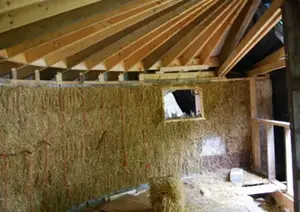
These closed systems are set against open systems, of which the names vary according to the scopes. In the field of habitat, we are talking of ecological houses. Mind, we will not speak of the HQE certification, which does not comply with several points mentioned hereafter. The ecological house’s aim is to be in osmosis with its environment: walls are breathing and perspiring [4]. It minimises its impact and looks for local solutions while using passive physics [5], biology and ethics [6]. In short, far from being sectioned off, these visions show many biophysicochemical relations, but also human ones.
In the field of organic nutrition [7], although the use of inputs is sourced organically, we are not either in a completely open system. Even if its name echoes biology and interactions of this field, we prevent the arrival of “plagues” by using methods not so harmful. The organic farmers are free to use or not to use hedges to let the living creatures go through, to help develop “threads for ecological continuity” [8], to use insects, bats or birds as biocontrol devices [9].
Agroecology and agroforestry [10] go further with an ecosystemic approach, ie an inclusion of the relations between the living creatures and the environment they live in. We thus think in terms of ’ecosystemic functions“ [11] and of”ecosystemic services" [12]. This vision is presenting a much more open system.
Other examples
We have defined a notion of closed or open system, but here are other possible parallels.
Medicine has made a lot of progress since its stammering debuts. Toxicology can come across obvious parallels with ecotoxicology. This is how we would not treat our environment in the way we would not treat our body.
Another well-known example through the advertising prevention slogan “Antibiotics are not automatic”. Indeed, the bacteria exposed to antibiotics evolve and develop mechanisms of resistance, a phenomenon called “antibioresistance”. If we focus on the word “antibiotic”, we can find biotic (related to living), so an antibiotic fights against a living body deemed as harmful. In farming, pesticides, fungicides, etc., are biocides which can be integrated as antibiotics [13]. Besides, the “plagues” can develop some kind of resistance. Under an open approach, they are sometimes of use, such as the function of mushrooms in the argile humic acid complex [14], the role of pollinating insects or yet the role of worms…
Another parallel, a living forest is host to a “balanced” diversity, well adapted to its environment with strong interactions. The same holds true for nutrition, which we aim to be diversified, balanced, well adapted with interactions such as our microbiot on the inside, and social interactions on the outside (local, organic, seasonal products…).
And you? Based on the TRIZ way of thinking, or open and closed systems, do you see other examples?
Credits
Photo of the article: hayley green CC-BY-SA
https://commons.wikimedia.org/wiki/File:Straw_Bale_House,_CAT_-_geograph.org.uk_-_1521510.jpg
