
 3 Rs, 5 Rs, 7 Rs, who can do better?
The 3 RS
It is a waste management strategy. The 3 Rs correspond to Reduce, Reuse et Recycle.
Originally, it was created following the implementation of the “Earth Day” in 1970 [1].
This word has only been in used in France since the beginning of the 2000s (by pioneers in the professional and university communities) [2]) and somewhat earlier for the Canadians (around 1990).
The Earth Day come from the USA, so we were lucky that, in French, the words came out with 3 Rs as well. That’s a relief!
Later on, we’ll be indulged with an increase of the number of Rs.
The 4 Rs
The 4 Rs correspond to Reduce, Reuse Recycle and Repair
The prevention theme is then more developed.
The 5 Rs
Down the road, in the “zero waste” communities, there are the 5 Rs. It is considered that the best waste is the one that does not produce anything. Thus, on top of Reduce, Reuse and Recycle, come Refuse and Compost (Sorry, Regrounded or rather the English Rot, ie decay, which is not quite the same principle as compost, but there was no better fit beginning with R...)
This principle has been popularised by blogger Béa Johnson [3].
The 7 Rs
Still in the “zero waste” communities, we now [4] talk of the 7 Rs [5].
The 7 Rs add on militant and eco-design aspects.
Reduce, Reuse, Recycle and Refuse are still present, and Repair, Reinvent andReclaim (closed in meaning to Claim which does not start with a R) are added [6].
Of course, one could argue that compost has vanished from the 7 Rs. Or that perhaps it is considered as recycling (however, technically, this is not the case).
In the same way, Reutilisation and Reuse are 2 different considerations. We talk of reutilisation if the object is not waste, and of reuse if it is waste. It is different from processing permits, salvage, terms of reclaiming process…
One absentee, Reconditioning, is a set of things allowing for Restoration.
Another process (when everything has been considered and under certain conditions) is energetic Revalorisation (=Upgrading).
Refashioning (the exact term is Makeover but does not start with an R) doesn’t count, as this would only be a form of Reutilisation or Reuse. Same goes for raw material Revalorisation (not to say Misusing, or even Recycling, Reutilisation or Reuse).
And what about Resilience in all of this?
To cut short, we can easily go up to 10, 11, 12 Rs if we dig deeper.
However, the big problem with the Rs seems to lie in the fact that we focus a lot on waste management and consumers. This is justified, as the first version of the 3 Rs is based on the consumer’s control of the waste he produces, while the most recent version is looking at a “zero waste” vision also centred on consumption.
Both approaches are a step forward on the waste issue, but the aspect of eco-design and environmental footprint of the production is, thus, not very present.
A mnemonic trick?
The X Rs are, above all, a mnemonic trick.
However, if it helps remember great principles, it also puts aside topics such as maintenance/cleaning, updates, misusing, composting, eco-design, direct distribution systems, [7], organic [8], the consumptions considered as immaterial per say [9], etc., and everything that does not start with an R, but does weigh in the creation of waste.
Anyway, if it is a mnemonic trick, it would be wise not to make a simplistic essentialisation approach out of a global issue.
It’s also important to take into consideration the pestilential financing practices, the lack of ethical practice fundings, the ecosystemic approach, the social issues, the environmental laws that are scorned and lack financial & technical means, the ultra-wealthy people who take advantage of tax optimisation and putrefy the earth, the pro-consumption lobbyists…
Moreover, pools of knowledge, training, blogs, books of good practices, etc, whether as part of exchange workshops, or by using open licences, are tools to increase awareness on the good practices.
Vision for a producer
Ranking processes for the producer would add on other considerations:
- Redesign (change practice, rethink of redesignate) ;
- Reduce (raw materials, waste, materials, incoming and outcoming flows generally…);
- Internally reuse raw materials, waste, materials, loss of flow (water, heat...), or sourced elsewhere if not available on-site;
- Recycle
- Compost;
- Salvage materials through third parties (importance of reusing the company’s outcoming flows so as not to generate waste);
- Residue process (organic process through phytoremediation or stabilisation process);
- Valorisation, including energetic upgrading as last resort and depending on the environmental and social impacts.
We could also think about this type of thematics for transport or sales fields.
More comprehensive proposal
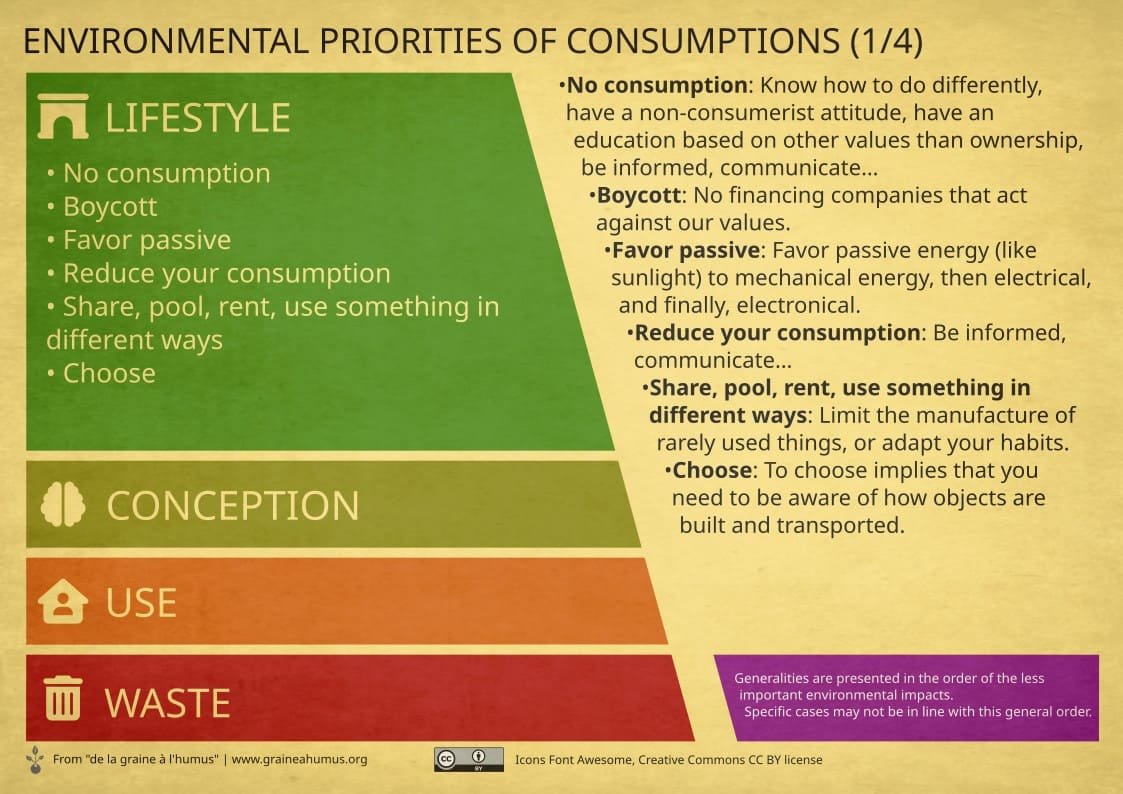
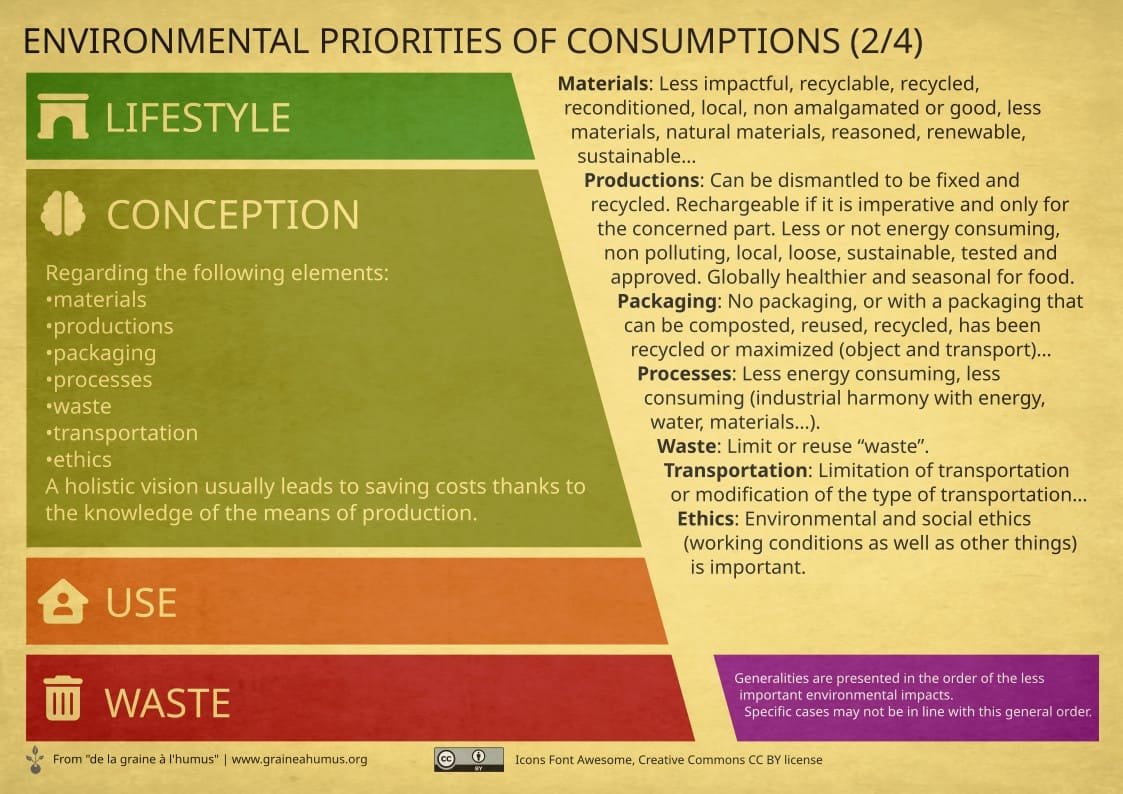
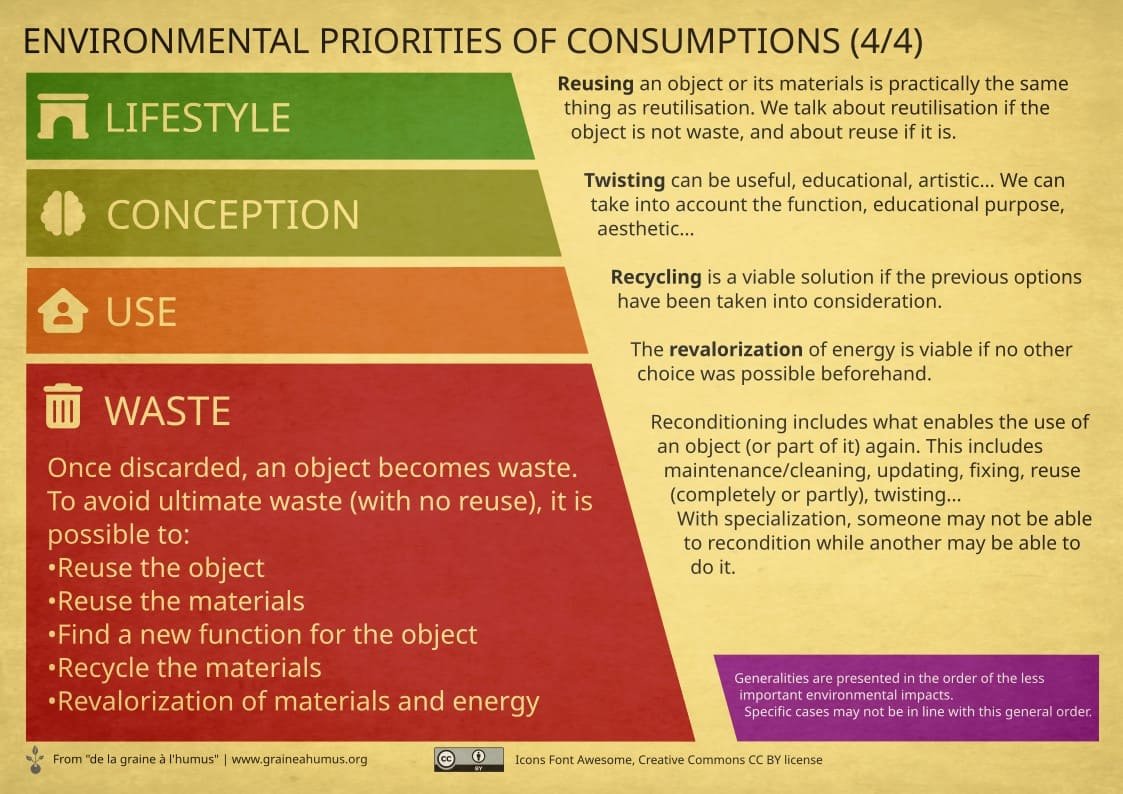
Here is the most comprehensive proposal of the steps for waste reduction. Everything is under open licence. We can supplement if there is anything missing!
Posters

Other ways to see it
The previous posters are just one way to apprehend things. Others are valid. Here below are other examples.
The Cycle of Life Analysis prism
Presentation with 5 videos, voiced and unvoiced.
Priorities
Prioritise the considerations we can have on consumption.

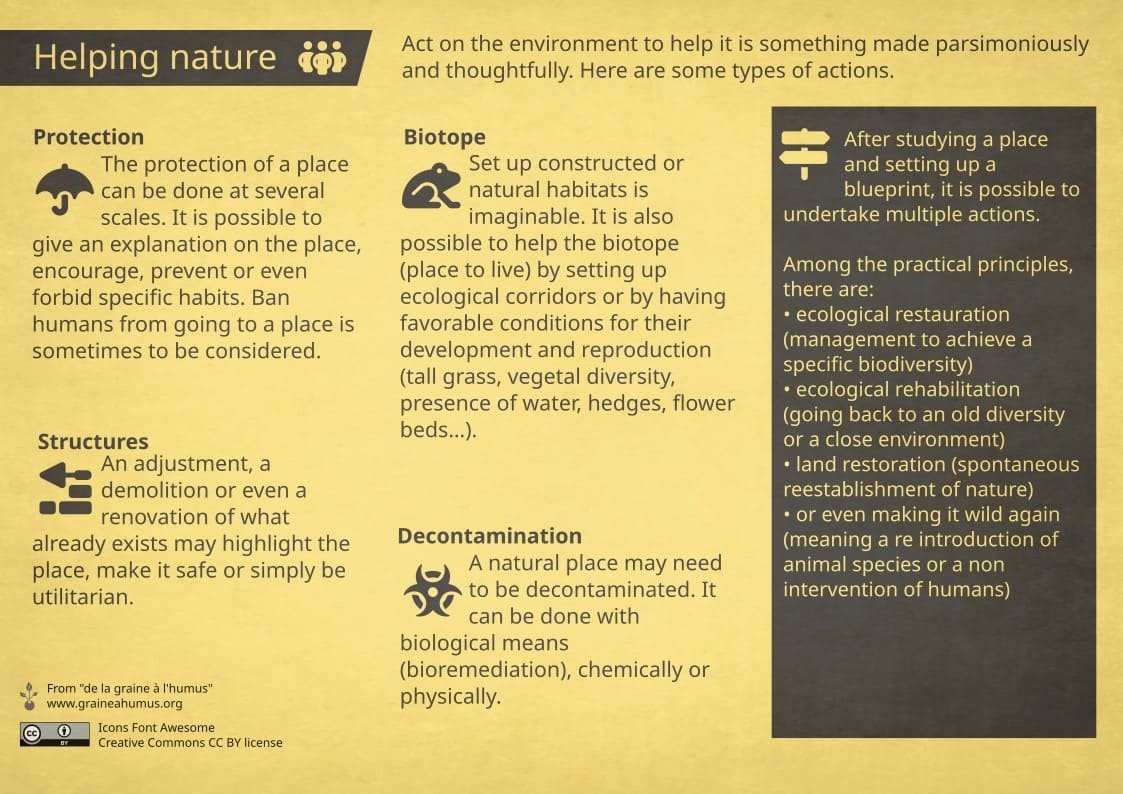
Prism of nature
Since the main reason is to see how we can reduce its impact as much as possible, is it possible to reverse the trend by helping nature?
Prioritise our considerations in terms of prevention of waste.

Remarks
We think it is important not to feel too guilty about the practices of other people. Nobody is perfect, and to do better in all kindness is already a step forward. Each to their own rhythm. Blaming rarely achieves progress.
The word “sustainability”, literally ’the capacity to sustain“(in the meaning of hold, carry), is global. Things hold until they reach their rupture point. This is the”weight" of the globality that we are considering, not an individual action.
And when we talk of “producer”, even a “consumer” is a “producer” to his own level (unless he is fully autonomous…). And conversely, a “producer” is very often also a “consumer” of other productions.
Source material


Original texts

Liens Wikimedia Commons
https://commons.wikimedia.org/wiki/File:Waste_prevention.svg
https://commons.wikimedia.org/wiki/File:Helping_nature.svg
https://commons.wikimedia.org/wiki/File:Mother_Nature%27s_10_Commandments.svg
https://commons.wikimedia.org/wiki/File:Environmental_priorities_1.svg
https://commons.wikimedia.org/wiki/File:Environmental_priorities_2.svg
https://commons.wikimedia.org/wiki/File:Environmental_priorities_3.svg
https://commons.wikimedia.org/wiki/File:Environmental_priorities_4.svg


