 Too much carbon kills carbon !
Introduction
The idea is not to bring criticism in a popular sense, it is to make an analysis about the limits of a doctrine or a group of concepts (thanks Wikipedia [1]).
The objective is to see the limits of the tools used in the context of the environmental crisis that we are going through and to see if they are suitable for what they are meant to do : alleviate the crisis.
Global context and history
First, we had to admit that we were exceeding some limits with our resource consumption. This was not the first time we became aware of it [2], but this time the situation was critical…
Thus, tools were set up to calculate the impact of human activity on the environment.
Life-cycle assessment
The Life-cycle assessment (LCA) was created in the 60s and became official towards the end of the 80s. [3]
The Life-cycle assessment takes an interest in a product or a service. During a Life-cycle assessment, we detail the impacts, some of which are not always included, according to their relevance for the study and/or according to the authors.
The sentence “from the global to the individual” is often used in environmental science. Deconstruction allows us to inspect every aspect before going back to look at it with a wider angle.
Within those impacts, we will consider climate change, global warming, the ozone layer, acid rains, toxicity, photochemical smog, fine particles, natural resources, eutrophication, ionizing radiations…
- Among the most famous impacts, there is climate change. It consists of disruptions that generates river floods, intense rains, droughts, rise or drop of temperatures…
- Global warming is mainly caused by greenhouse gazes (GHGs).
- The natural ozone layer is often listed. It is located in high altitude and is protecting us from the ultraviolet light (UV) emitted by the sun.
- Acid rains are harmful to the fauna and flora. They are causing the degeneration of some forests.
- Toxicity is also studied, either on humans, on ecosystems or more specifically on aquatic environments.
- Photochemical smog is an urban grey fog hovering in cities. It causes, among other issues, respiratory diseases.
- In the respiratory category, fine particles are also studied. They are displayed in the Air Quality Index.
- The impact on natural resources is studied with several criteria : the use of non-renewable natural resources, the use of water, the energy consumption, land occupation…
- The terrestrial and aquatic eutrophication (river or sea) brings an excess of nutrient resulting in the disruption of the ecosystems’ balance.
- Ionizing radiations are related to the radioactive emissions and the damage it caused to human health or to the environment.
- Finally, some less-used LCA technique study elements like the harmful effects of smells as well…
We then obtain an overall impact score by weighting specific scores of every aspect.
Critique
To date, LCA is still the most complete view that we have.
We have to become aware of some limits of LCA while keeping in mind that taking everything into account is difficult, if not impossible.
- Some criteria may be related to one another. Theses connections can be direct or not, known to us of just assumed. A Life-cycle assessment can perceive those criteria even if it is not always easy to define some links or causal relationships between them.
- We can note as well the lack of some environmental criteria, like the soil erosion that might lead to dust-bowls. You can fight the erosion of the soils by feeding back the nutrient matter to the soil, with a compost for example. We can compost most of our domestic wastes : around 30% for the food wastes, 85% if we include urine and fecal matter. This aspect is also not used for LCA. [4]
- There are several ways to weight the scores and it may change the results.
- There are varying representations, with some easier to read for someone with no experience. It can take the form of numbers, radar charts, petal charts, bar charts… The choice of the study’s subject and its representations will influence the feedback of the study.
These criticisms may be known by experts in the domain. It is possible to use other tools to complete our approach and avoid some “traps” by using data, study frameworks and representations that are clear, complete and suitable for the study [5]. - Some less-used LCA technique study elements like the harmful effects of smells or noises as well…
Ecological footprint
The ecological footprint was discovered in the 90s by Mathis Wackernagel and William Rees. They both have university backgrounds, the first having a PhD degree in community and regional planning and the second having a PhD degree in population ecology.
They looked more closely at the impact of human activity on Earth, otherwise known as environmental pressure.
Although less complete than LCA, this view focuses on the impact of human consumption and not on the impact of productions. This gives a new perspective. Although, the notion of exploitation of land still links to the production.
Critique
There are in this view several criticisms.
By focusing on humans, we are getting a new view, which is a good thing.
However, everybody that calculated their footprint knows that even the most planet-friendly habits are not enough.
More than a single planet would be necessary for our way of living to be sustainable in the long run, even if everybody had the most planet-friendly habits…
We will tackle this point at the end of this article.
Carbon footprint
Created at the start of the 21st century, carbon accounting is a simplification of the existing methods.
We only see the environmental impacts through the prism of CO2 and global warming.
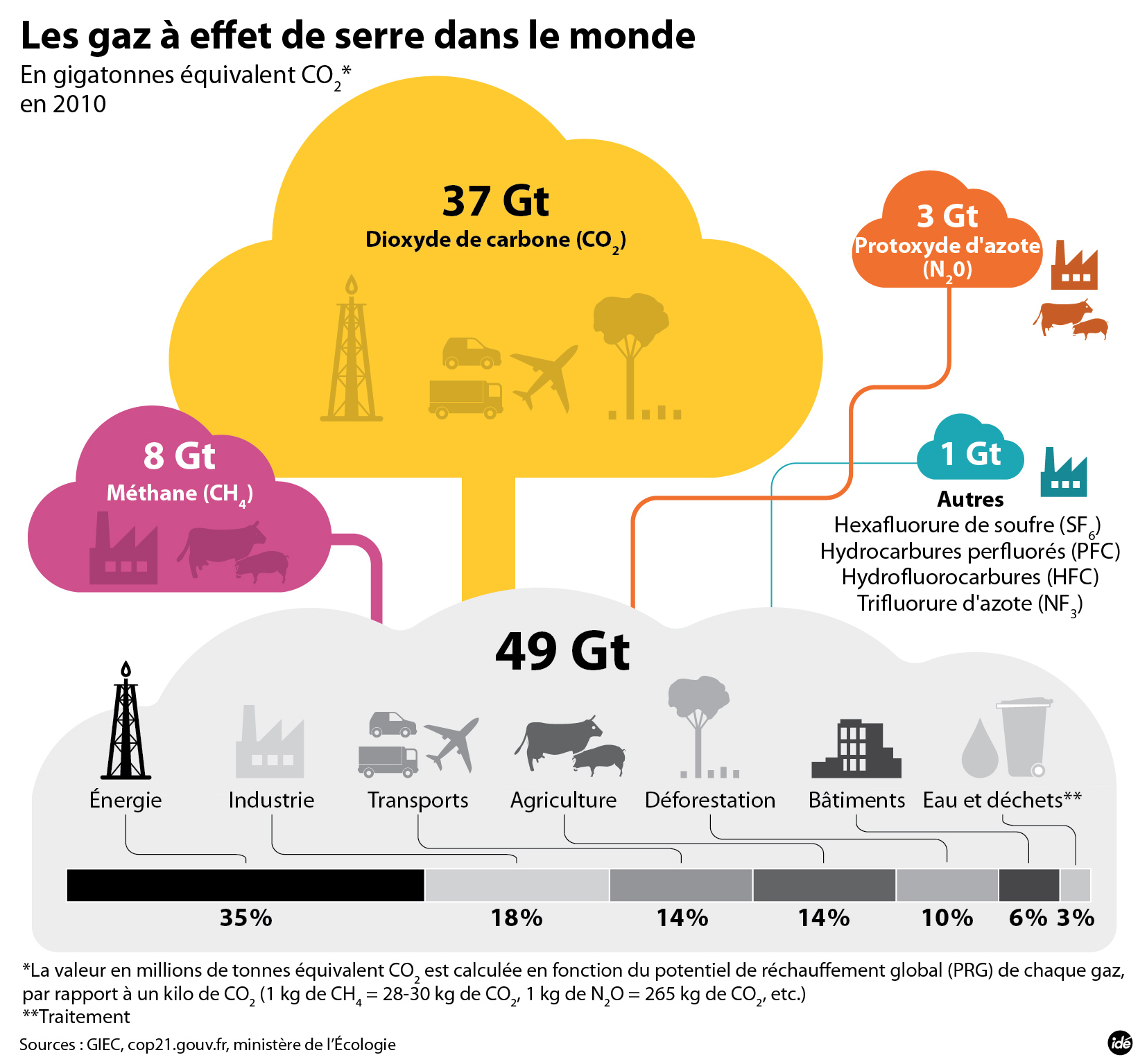
In the carbon footprint, the CO2 acts as the base and is equal to 1. We can calculate everything from this. An index known as the Global warming potential (GWP) enables us to include other gases, like methane (CH4). The GWP of methane is 28, meaning it is 28 times more impactful than CO2 and is responsible for 16% of human-made emissions. [6].
Critique
This is a very simplistic view and it is actually very appreciated by the big polluters. Some companies showcase this method as it is not looking at the service provided or the products. It only looks at the consumption. [7] The consumer is then the one who is responsible.
Furthermore, we saw with LCA that several impacts are invisible with this method. Of course global warming is a real issue, but being able to drink, eat, breath and being healthy is equally important to live.
Carbon accounting only takes into account the carbon, and that is its greatest drawback.
Being even more efficient than forests, plankton is the first producer of oxygen and captures CO2. [8] Thus, the acidification and eutrophication of the aquatic environment are affecting the CO2, meaning they also affect global warming. However, they are not taken into account for carbon accounting.

Source

It is leading us to put aside an important part of the carbon footprint by focusing only on the direct impact of carbon…
Life is entangled in several mechanisms : there are cycles, food chains and retroactive loops that must be taken into account.
Environment engineer feedback about the Carbon method
I had the chance to use the Bilan Carbone® method that is in use in France. It was a request and the method was a demand.
With this method, the data was imposed, contrasting with the LCA where we can choose the approach and data according to our subject of study. The method is “standardized”, meaning we can not stray from it or make criticisms, even with numbers or specific sides of the approach as proofs…
I was double checking the source of the data as I wanted to use valid data and I did not want to use numbers that I did not understand. At that moment I realized several things.
The numbers were not coming from experts, and some values heavily seemed to have been selected to serve a personal agenda. Indeed, when a large amount of diverse data existed, a specific selection was made by ruling out some of the data. All of this happened without any explanation of that choice.
The standard deviation of the uncertainties were not justified and completely “butchered”. The numbers were suspiciously round, which was very unusual.
The sources were often not available.
It was impossible to give a feedback or work together. We could not even have a basic scientific approach.
More accurate data existed but it was not suitable to confirm the calculation with a method. To confirm the calculation, we had to use official numbers, even if they were old or inaccurate.
There were even addition errors…

Here, in “Calcul des facteurs d’émissions et sources bibliographiques utilisées (version 3.0) AVRIL 2005”.
The total amount indicated is 350.6 while it is 344.5 for the equivalent kg C if we do the addition.
I tried to reach out to the author twice (Jean-Marc JANCOVICI, I did not know him at the time) as well as the ADEME (The French Agency for Ecological Transition) to report the errors but I never had any answers…
Leads for solutions
First, a tool remains a tool. However complete they are, they cannot do everything. Changing the approach and using several tools according to the contexts is normal.
Then, data based on the knowledge of society are to be favored against private and/or ideological interests. For example, Open LCA is free and enables access to thousands of pieces of data on https://nexus.openlca.org/.
It is also expected to rule out data that have a conflict of interests to avoid cognitive bias associated with it.
Being open to criticism to improve yourself is a norm in science, the same goes for peer review. Every tool with suspicious methodology and that is not accepting open collaboration are to be avoided. The source must be accessible !
On another concern… Let us go back on an previously mentioned issue in this article : “everybody that calculated their footprint knows that even the most planet-friendly habits are not enough. More than a single planet would be necessary for our way of living to be sustainable in the long run, even if everybody had the most planet-friendly habits…”
So, is it already over ?
No, as footprints do not take into account the ecological design and other improvement made by the producers. On the same idea, footprints do not take into account the initiatives with positive impacts like fixing to avoid wastes and production, lending, sharing, donations…
We can also talk about land restoration : building ecological corridors, growing cuttings, strengthening the ecosystems, building passive houses…We can mention as well all the public policies that can be set up like free or low-cost public transport, building safe cycling path, local shopping and less meat for the school canteens… In short : it does not take into account a lot of aspects. We tackle a lot of feasible actions on our website : https://www.graineahumus.org/
To conclude, let us also come back on a technical point that we discussed : the methane (CH4)
The methane has a GWP of 28, meaning it is 28 times more impactful than CO2. However, the lifetime of CO2 in the atmosphere is around a 100 years while the lifetime of CH4 is around 10 years. The methane emitted by human activity in the atmosphere represents 16% of the total human emissions, it is the easiest solution for us in the medium term, by limiting our consumption of red meat for example.
It would also be possible to greatly limit emissions of halocarbon like CFCs and its by-product. They last up to 50,000 years in the atmosphere, and for now they are only piling up !