
 Reduce biowaste
Implementation
- Introduction : presentation of the association and the context
- Define : waste, biowaste, biostabilisation, percentage of the waste in question
- Provide information (maps)
- Adapt the method in seven steps (https://www.graineahumus.org/tools?lang=en)
- Define the question (1 piece of waste, 1 map)
- Individual reflection on waste
- ThinkTank and grouping (garden, kitchen, body, animals, sawdust, paper of which wet paper, food waste, kitchen waste...). (general)
- Deconstruct again, deconstruct again (private individual).
- Classify (paper with 1, 2, 3 depending on how far on the list it is. Start with 1 then 2, then 3)
- Exchange some solutions for each map (Boundaries : legal, social, ethical…)
- Search for resources (search...)
- Compile results
Tools
- Contact sheet
- Notes / pen
- Maps including possible approaches
- White paper for brainstorming
- vcard / Flyers / Stickers (for communication purposes)
Onsite : chairs, table, internet.
Programme
Introduction
- Presentation of the hosting association.
- Presentation of the context.
The collective does not define public intelligence.
Allowing everyone to express themselves, not influencing anybody else, generating stimulation, constantly going back and forth between collective and individual. All of this requires organisation.
Definitions
Defining the terms allows us to agree on the outlines of the topic we are talking about.
Waste
A piece of waste is, under the law, any residue generated by a production/transformation or usage process, any substance, material, product, or more generally, any piece of furniture that was dropped off or that its owner wishes to throw away.
https://www.legifrance.gouv.fr/loda/id/JORFTEXT000000888298/
Biowaste
We didn’t take the legal definition of the environmental code mentioned hereafter, here, but the following definition :
« Non dangerous Natural organic material waste (material produced by living beings). »
This is a slight simplification of the definition. We only take into consideration the waste produced by private individuals.
« Non dangerous biodegradable waste from gardens or parcs, food or kitchen waste from households, offices, restaurants, wholesale trade, canteens, delicatessen or retail sale trade, as well as similar waste from food processing factories. ».
Article L. 541-1-1 of the Environmental Code
Biostabilisation
Make biowaste passive and less dangerous for the environment.
Percentage of our waste affected
Here is a overall view of our waste.
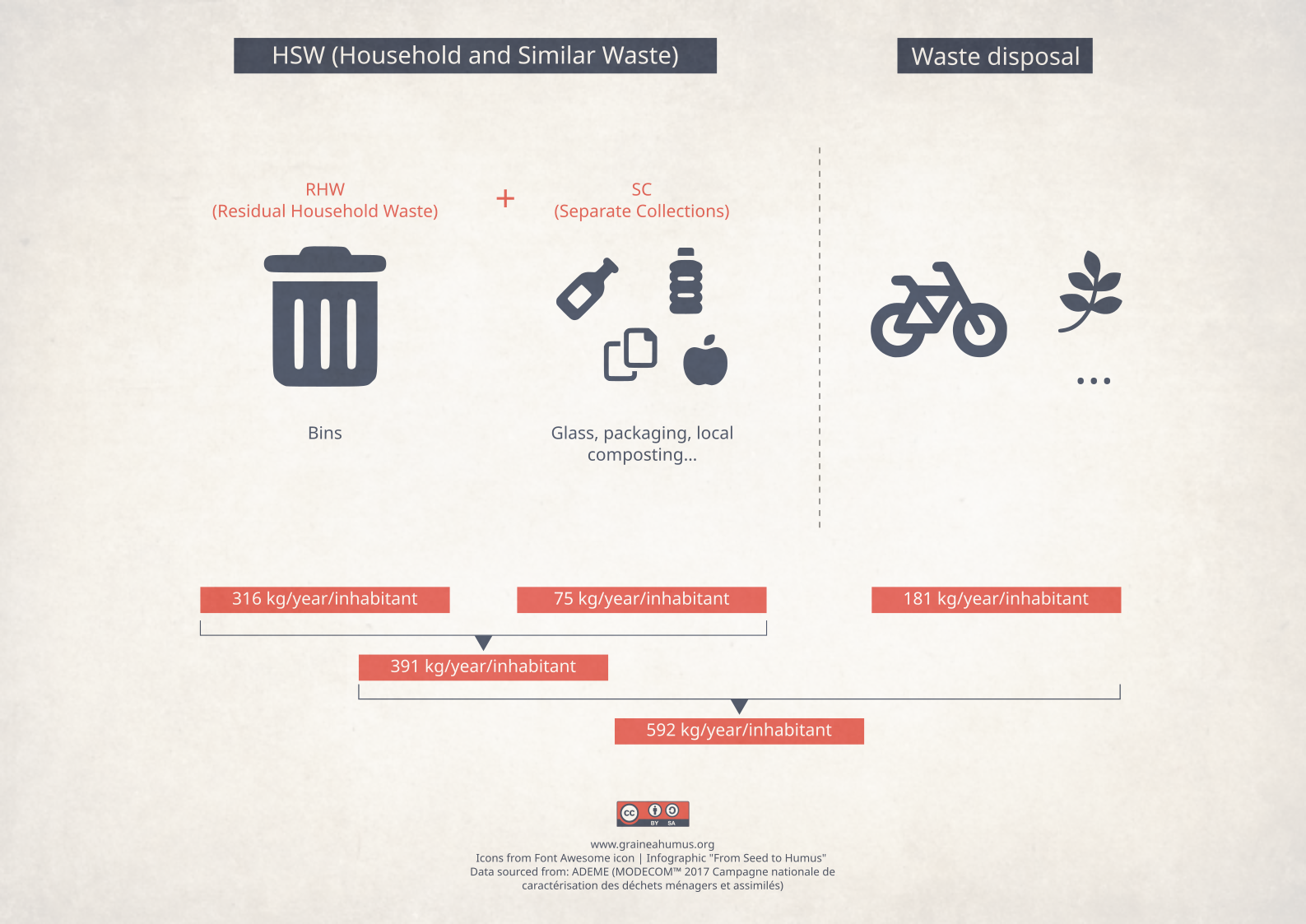
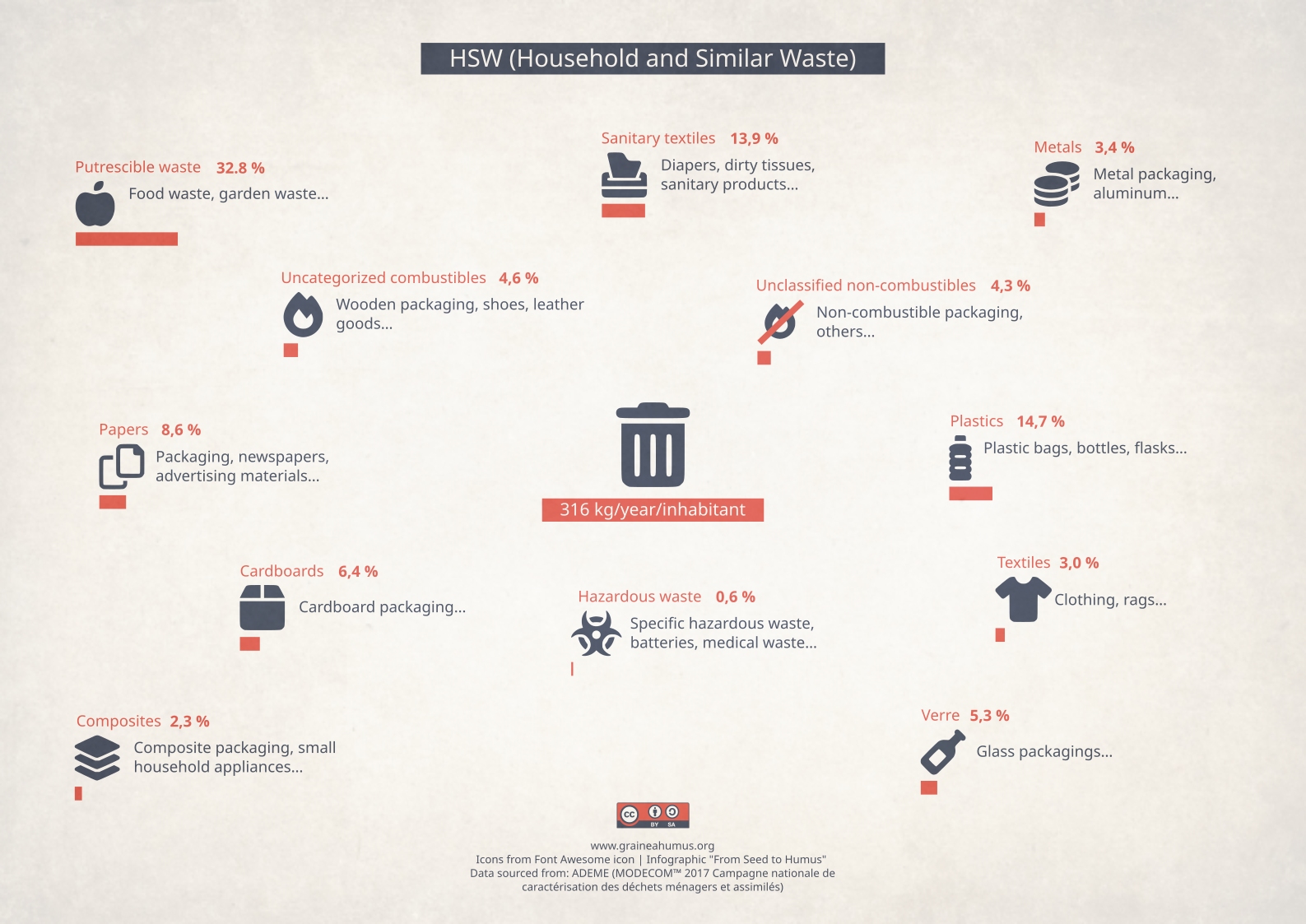
A third of our household waste are putrescible elements.
A large portion, which also meets the definition of waste, comes from toilets.
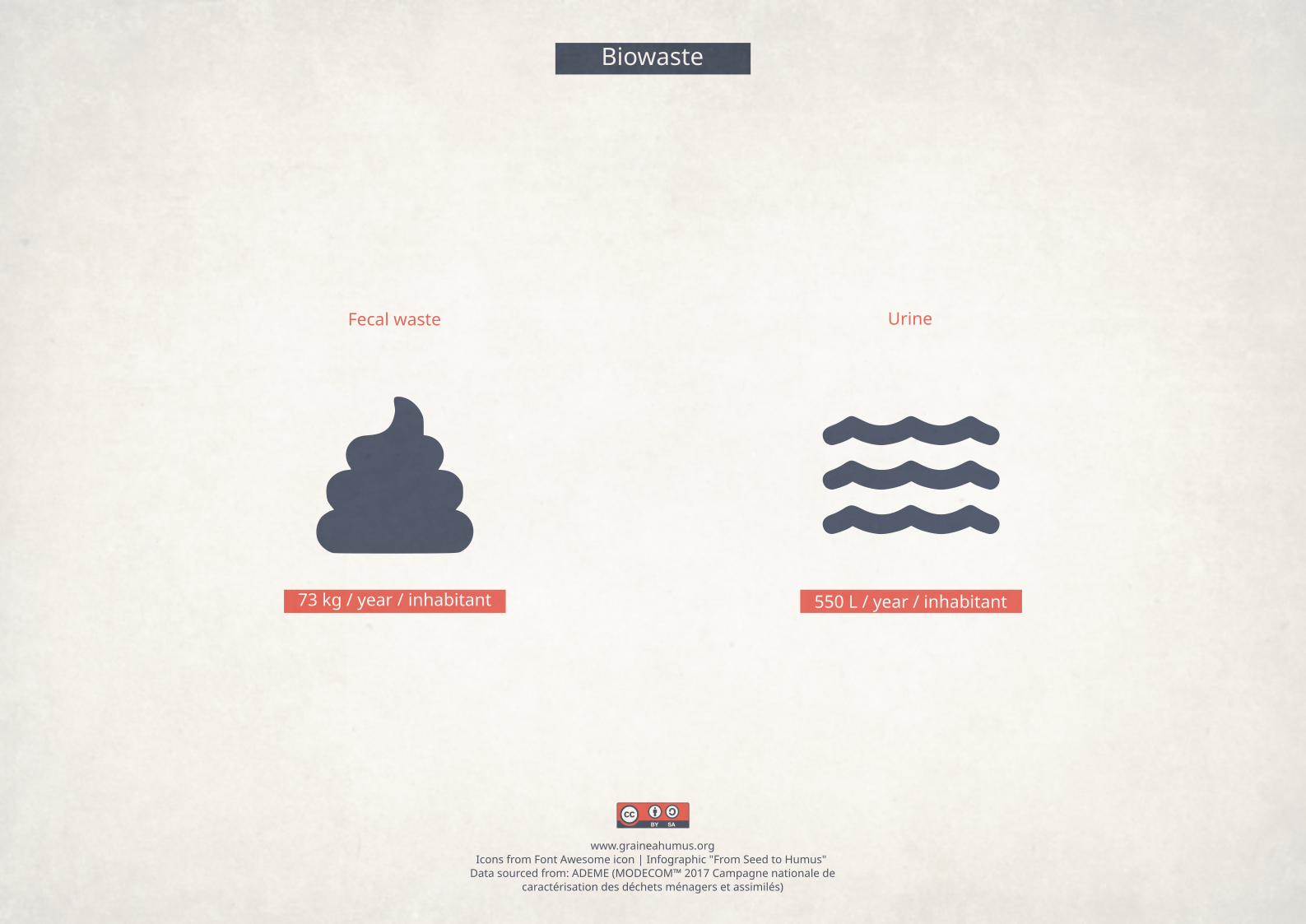
If we consider faecal material as waste, then nearly 50% of our waste [1] is compostable and help feed the soil.
If we also consider urin, we then reach 77% of our household waste to be compostable !
Details and sources on https://www.graineahumus.org/reflexions-sur-les-dechets
The cards
We show cards with concepts which we might benefit from later on.
- What we wish to avoid : waste (of which Compost and Fermentation).
- The Fermentation refers to methanisation in this case, but it can also be a means of preservation (lacto-fermentation).
- On the principle of « the best waste is the one that doesn’t produce anything », we also avoid composting whenever possible. It’s best to finish your plate that compost it.
- Circular economy classical methods (Reuse / Reemployment, Reconditioning, Upgrading, Diversion)
- Reemployment : Use all or part of an object for the same use as the one it was intended for, or for another one.
- Reuse : Use all or part of an object considered to be waste.
- Reconditioning : Refit an object in its original use.
- Upgrading : Restore some value to an object.
- Diversion : Use the object for another use for which it was intended for.
- The ways of life with an impact on the reduction of waste or their environmental impacts.
- Sharing
- Replacement (by an object with a smaller impact)
- Diogenism
- Minimalism
- Voluntary simplicity
- Pragmatism
- Donations
- Refusal / anticonsumerism
- Self production
- Degrowth
- Ethics
- Local
- Organic
- Healthy
Document

Source

Adaptation in the methods in 7 steps
(See details on the method here https://www.graineahumus.org/boite-a-outils?lang=fr)
- Defining the question (In this case, mentioning biowaste : 1 piece of waste, 1 piece of paper)
- Individual reflexion (We ask each person for 10 pieces of waste)
- Poolsharing and creation of groups. (General aspect)
- Whenever necessary, deconstructing each piece of waste (Particular aspect)
- Ranking
- Exchanging on potential solutions for each card
- Searchin for ressources to obtain more results
Here are the results obtained on the first session :
- Food waste
- Coffee ground : pipe, fertiliser, mounting for mushrooms, sandpaper
- Peeling : kitchen, lacto-fermentation, pickles, crisps
- Citrus fruit rind : make preserve, deodorising, zest
- Banana skin : fertiliser (Potassium), plant-based bacon
- Expired food : cook again, freeze food that will soon be expired, stewed fruit / jam / marmalade, preserve before expiration (Lacto-fermentation, vinegar : Pickles, oil, salt : brine)
- Sub-products
- Soiled oil : petrol, filter for reuse, natural treatment
- Bone : marrow for dog, animals, broth, soup, gelatin, crushed for ground ?
- Soiled water : cleaning, watering, washing
- Ashes : abrasive, anti-parasite, donkeys, soap, exfoliating
- Cooking water : broth, pipes, weedkilling, watering, (careful with the salt !)
- Green waste
- Shavings : absorbant, parcel, dry toilets
- Sawdust : dry toilets, absorbant, repairing wooden glu mix
- Grass mowing : mulch, mix with leaves to the mower, ecological corridor
- Plant/tree pruning : habitat, straw-mulching, heating, objects
- Leaves : habitat
- Human/animal body
- Urin : fertiliser/pesticide, split it in a can with oil
- Faecal matter : compost, brick or coating with manure.
- Nails/Claws : keratin.
- Donate to associations, fertilisers, bird nests.
- Table waste
- Hard bread : breadcrumb coating, pain perdu, stuffing, powder for cakes
A compilation will be carried out to lay out these results. In order to validate and complete these details, there will be other sessions with other people, checks on the validity of these elements and further matieral with other sources of information.
Sources to exploited
https://www.syvadec.fr/filiere/dechets-alimentaires-biodechets/
https://www.alsagarden.com/blog/les-cheveux-coupes-un-engrais-naturel-pour-votre-jardin/
https://www.terresoleopro.com/astuce/que-faire-de-lhuile-vegetale-apres-avoir-fait-une-friture/