
 Low-tech et technology
There are numerous techniques with a lot of miscellaneous impacts. Linking them between themselves is not an easy task. Indeed, it is difficult to correlate a wooden pen with a nuclear powerplant…
For environment-related techniques, it might be possible to categorise them. For example, we could have something like this :
- The products with a low impact (local, hand-crafted, organic…) ;
- The consumptions with a low impact (in bulk, local, ethical…) ;
- Restorative or nature-protective actions (ecological restoration) ;
- Passive structures (building insulation, light shaft…) ;
- Apps for energy-hungry technologies (heat pumps, double-flow Controlled Mechanical Ventilation systems…) ;
- …
Providing a view of the plurality of the techniques helps not to take any easy shortcuts, but it is spurious.
It should be specified that, for each practice, we can have outcomes that are more or less favorable for the environment. Yet again, « to think global » proves useful. The impacts and the steps seen in the Life Cycle Analysis give us an idea of the themes underlying the production of an object or the use of a service.
Definitions
Let’s start with technology(ies). Like many other words, this is a polysemous one [1].
Etymology
The word technology comes from the Greek « technología » (τεχνολογία) ie. téchnē (τέχνη), « art », « ability » or « craftmanship », and « -logía » (-λογία), the study of one branch of knowledge, of one discipline.
So technology is the study of the arts, craftmanship, trades, applied sciences of a branch of knowledge at the various historical periods, in terms of tools and skills. In its original meaning, technology is descriptive [2] and non-descriptive [3].
If we stop at this definition, the first known technique to this day comes from the Palaeolithic era, some 2.6 millions years ago with the discovery of the oldest carved stone tools in Africa (Ethiopia, Kenya) [4]..

Stone carving is a genuine revolution in the history of mankind. In time, stones have had more and more specific functions. [5]
1-Converted pebbles from Oldowayen. The oldest Oldowagen tools discovered to this day date from 2.55 million years ago. There were discovered at Kada Gona in Ethopia.
Image by José-Manuel Benito Álvarez aka Locutus Borg (Licence CC BY SA).
2-Two-sided stones from the Acheulean site. The first Acheulean tools emerged very early on, 1.76 million years ago. The oldest tools are known both in the Turkana area in Kenya and in the south of Africa.
Image by José-Manuel Benito Álvarez (Public domain)
3-Levallois and Moustérien Method. This function appeared quite early on in Africa, between 500 000 and 400 000 years ago.
Image by José-Manuel Benito Álvarez (CC BY SA licence).
4-Blades and the Aurignacian way. This method corresponds to the Upper Palaeolithic (45 000 years before present time).
Image pb
Common sense
In our daily lives, we use the word technoology in a more common sense. The edges are more blurred, but we can often see clear characteristics.
Approach through production
As regards to the object itself, we will talk of technology for industrial productions or unique productions using advanced techniques (generally electric or electronic techniques, but not exclusively…).
This approach of the word « technology » is also reflected in Jacob Bigelow’s work. This Harvard professor seems to be the one who, for the first time, formalized the systematic use of the word « technology » in English in his work « Elements of technology » (1829).

Boards from the book « Elements of technology » (1829) by Jacob Bigelow. (Public domain))
Bigelow proposed the merging of the arts and sciences on the dawn of the Industrial Revolution. He incited towards a heightened division into sectors of the scientific knowledge and a scientific allocation of tasks in the work sphere. The first uses of the word « technology » in the sense given by Bigelow thus preceded the technical, environmental and social upheavals of the 19th century, and its use spread during the Industrial Revolution. [6]
Bigelow was influenced by engineer John A. Etzler, who had a religious dimension of the technique and would spread out his ideal four years later in a book which would be quickly and widely acknowledged : « The Paradise within the Reach of all Men without Labor, by Powers of Nature and Machinery : An Address to all intelligent men ». [7]
This school of thoughts could be called the technological fix. According to this concept, all problems could be fixed by « better and new » technologies [8].
Bigelow and Etzler are millennialists, a resurgent current of that era. They thought the Messiah would come (back) to Earth. It was, thus, a question of preparing paradise. In their minds, machinery and nature helped abolish work, subsequently helping the most disadvantaged social classes. There was a preparation of the last judgment, with a terrestrial messiah who would chase away the antechrist. « In helping the most deprived, you will receive in return during the resurrection of the righteous » [9].
Production-driven and capitalistic considerations on the Industrial Revolution, the heightened division into sectors of scientific knowledge and task allocation [10] will bring their share of problems. We can quote, among others :
- the loss of autonomy by not knowing all the stages of the processes ;
- the ignorance of productions (their uses, their sources, their social impacts…) ;
- the creation of various types of pollution ;
- the decrease of resources (their time limit had not been considered at the beginning) ;
- work conditions which do not improve with increasing productions ;
- the large transformation of landscapes by increasing exploitation ;
- the disappearance or increasing scarcity of handcraft trades ;
- a growing consumption ;
- a growing dependency on productions ;
- …
Approach through the product surroundings
Nowadays, we also think about the technologies surrounding us and about their impacts on our daily lives, on our ways of life These technologies are mirroring how one sees the world, thus creating dependency.
A wooden pen or a ballpoint pen are rarely considered as technologies in the common sense. Yet, when we focus on learning how they are made, they prove to be advanced or even well-advanced fabrication techniques.
Nonetheless, we more often use a pen to take notes, scribble, draw… [11] We keep a certain control on the use and on the production undertaken. For simple uses, we just take any pen we come across, of any brand or fabrication technique, as long as there is enough ink or the lead has been sharpened. We absorb the tool and do whatever we wish of it, it barely requires anything from us…
With technologies such as the internet, we have less control on how we use it. Algorithms are like inciting forceful tools of informative bubbles, forecasts of our expectations, access to information that change our vision of the world, counterfeiting information through mass sharing… The tool becomes less insignificant…
Critical reflections on technologies
Critical reflections on technologies are not new [12].
There are many forms of criticism on the productions and conditions thereof.
We can name multiple aspects, such as appropriation or reappropriation questions [13], mentioned by Karl Marx as early as 1844.
There is also DIY [14] with magazines such as « Popular Mechanics »(founded in 1902), though this was a niche issue at the time [15]. This reflection has, then, been evolving gradually along with the flourishing industry and adaptable human beings. In France, criticism was more discreet during the French Glorious Thirty, a period when consumerism was in full boom. The technocritical reflection appeared to be on the rise again at the beginning of the 1970s when the ecological crisis became obvious. It then teamed up with ecological yet still remaining critical of it [16].
The word « technocritical » was founded in 1975 by French engineer and philosopher Jean-Pierre Dupuy.
The technocritical neologism defines a school of thought based on the criticism of the « technical progess » concept, thought to be an ideology born in the 18the century during the Industrial Revolution and which has, since the Second World War, been rooted in consciousness mainly through the outcomes of automation (mechanisation or machinism) and computerisation [17].
The concept of low-tech dates back from the 1970s, when it emerged under the pen of Ernst Friedrich Schumacher [18].
The word « low-tech » is a vision of the world. It can take into account various elements such as :
- the finiteness of ressources ;
- various environmental problematics ;
- the work conditions and other social aspects ;
- the reappropriation of work tools and techniques ;
- simplicity (of production, repair, future waste treatment…) ;
- the use of local resources ;
- zero-waste ;
- the place of the citizens, of the human-beings or of the living more generally ;
- sharing ;
- …
It should also be noted that numerous low-tech productions are available in free licenses, as opposed to intellectual propriety which puts a stop to sharing.
The drawing on the following page shows a plural approach of low-techs.
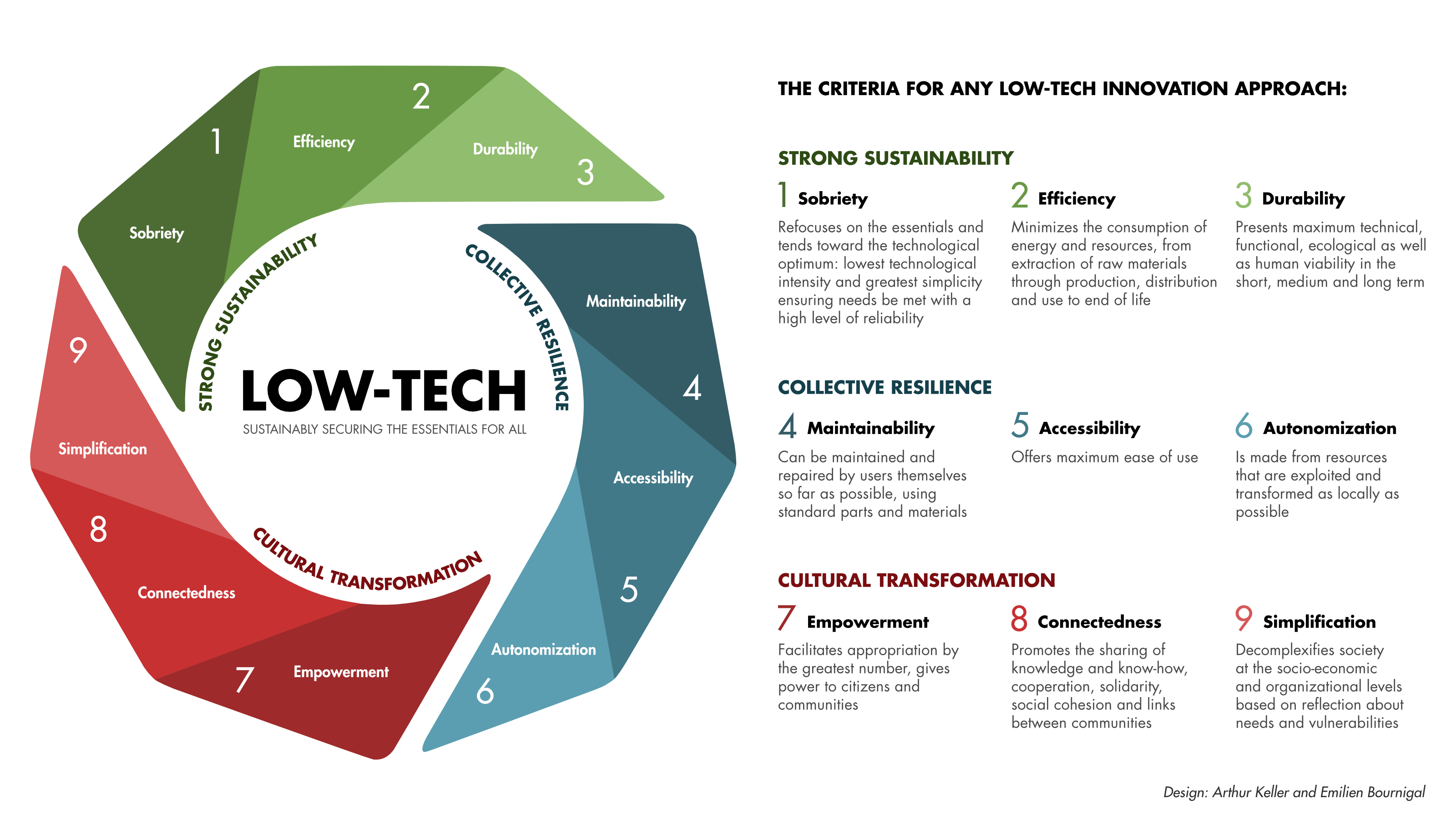
Authors : [Arthur Keller and Émilien Bournigal, CC BY SA- licence >https://commons.wikimedia.org/wiki/File:Innovation_low-tech.jpg].

Future of low-techs
We wish low-techs a bright future ! But here is the thing…
Some great initiatives have been taken by the systems they were fighting against.
We can mention free culture, which aims at sharing the code and intellectual proprieties in a general way. It has been increasingly spreading into companies, as open source or open data, as a mere production tool, because it is free, and can legally be modified by everyone for their own requirements. We can see the appearance of some criticism here or there. According to Richard Stallman, the fundamental difference between the concepts of free and open source lay in their respective philosophies : « Open source is a methodology of development ; free softwares are a social movement ».
Here is another example. Organic cooperative stores are less and less co-ops of associated consumers and stakeholders to procure organic products. Many still keep the « cooperative stores » designation while being a co-op made of owners from various stores… These reasoning threads generate social anger.
One last example concerns food : organic food or products with protected designation of origin, are initiatives stemming from genuine roots. Increasingly stronger lobbying practices make them highly problematic…
Tomatoes organic and grown under greenhouses in winter authorised again in France, AOC/AOP designations [19] with production methods for the profit of industrialists and not for the small local producers…
Concepts for the well-being, whether they are social or environmental, have been denatured at the time of their appropriation, by companies which took the ethical dimension away. Are we facing the same situation with low-techs and companies which would keep the eco-design aspects at best, but would take away the social aspects (free licence, workshops on sharing, cross-cutting decisions…), but also some environmental aspects (sobriety, sustainability…) ?
Organisations such as Veolia are already appropriating the word « low-tech » which is often seen in numerous communication videos [20]…