
 Compostable waste
Of course, we do not have 100% of the solutions regarding environmental issues. What if we knew already 95% of the solutions, but they were just not implemented yet ?
Yes, we need financing, yes we must guide the changes, but after all, we are talking about keeping our world habitable for humans and other living species. It is worth trying, is it not ?
The following article tackles the subject of compostable waste.
Are only 30% of our waste compostable ? Is that true ?
This article is based on French numbers [1], but the approach is rather similar for the countries that are said to be “developed”.
Characterization of domestic waste
We will talk about domestic waste, commonly named household wastes.
Let us start from the beginning…
There are several types of household waste.
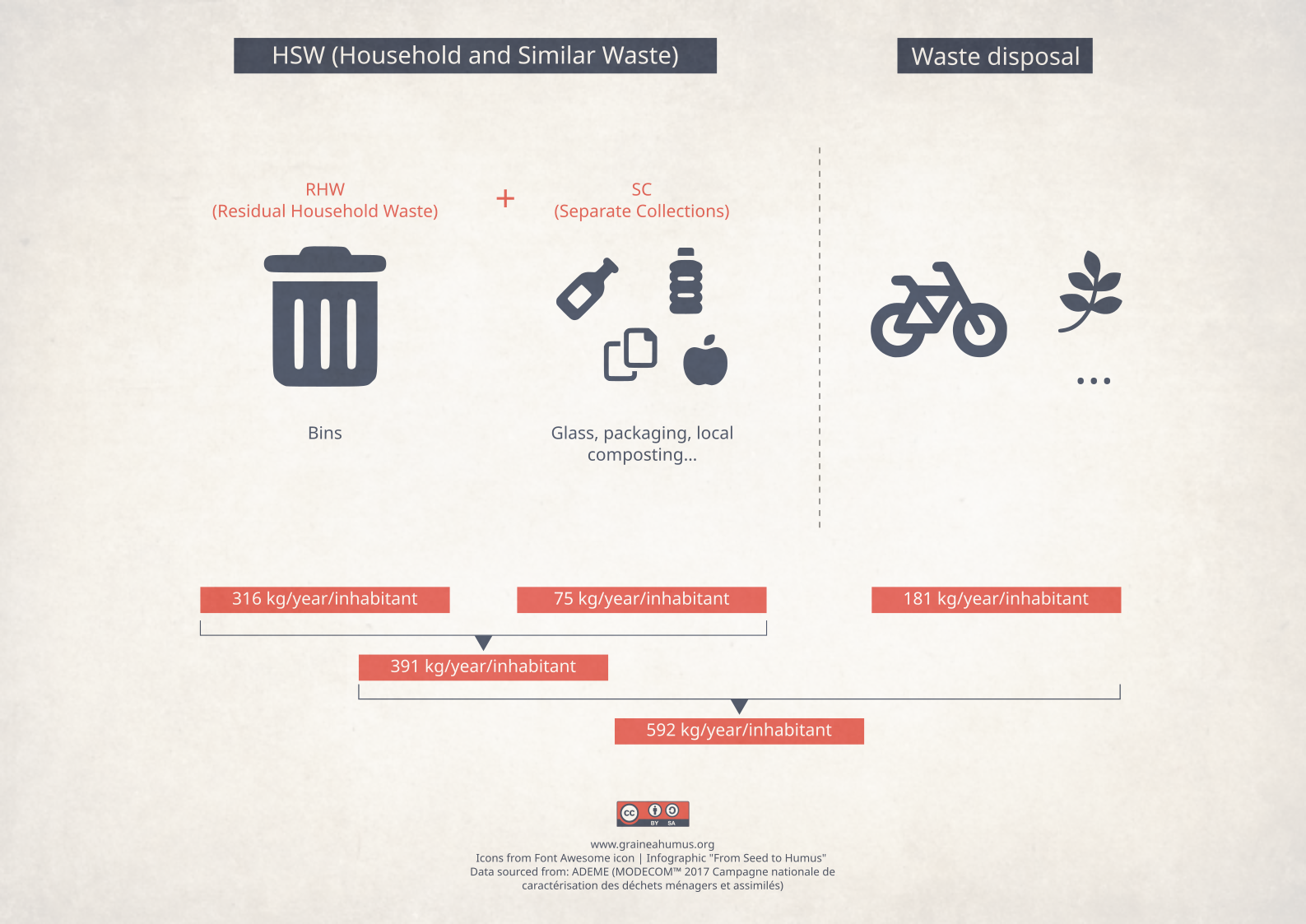
The residual household waste (RHW), to put it simply, trash cans. The specific fraction of waste (glass, paper…), making the separate collection of waste (SC). If you regroup the two categories together, we have the household and similar waste (HSW).
We are only missing waste disposal to have the total amount of household waste.
It will be easier with a drawing.
Source in svg

Characterization of household waste
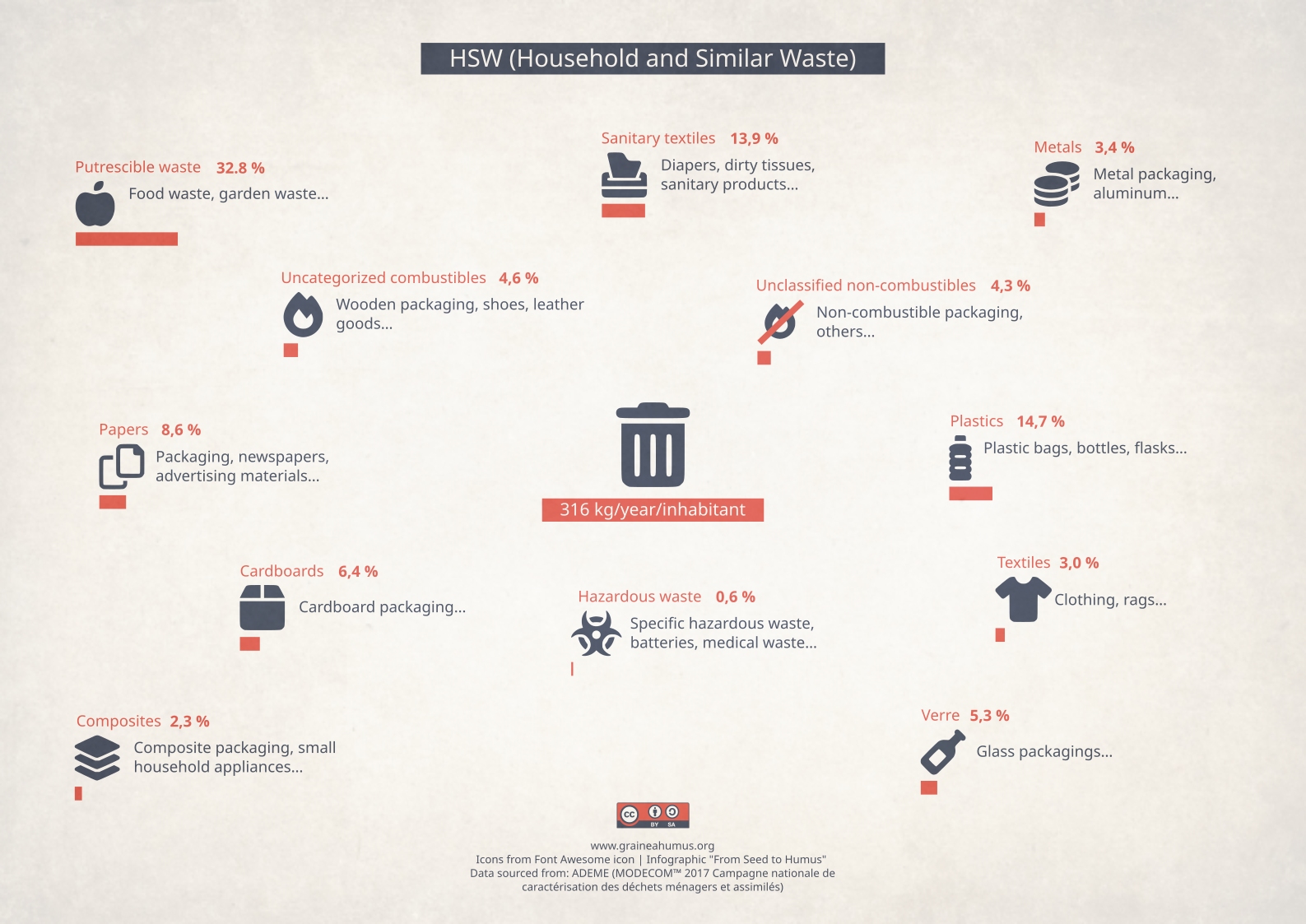
We often hear people say 1kg (2.2 lbs) of waste per person per day for the household and similar waste. It is an estimation rather close to reality.
If we look at the average composition of trash cans, we have the following.
Source in svg

Addition of human waste
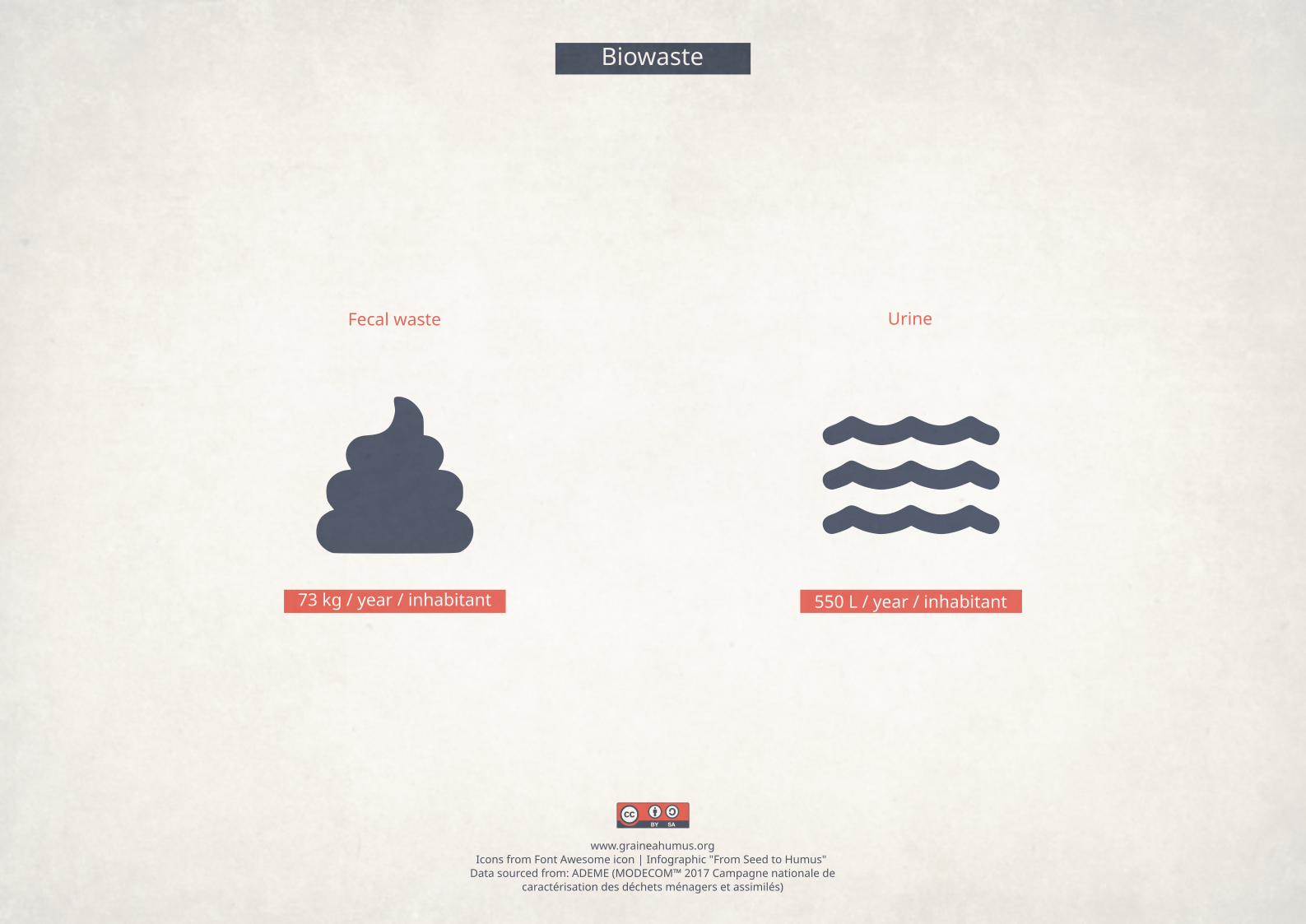
We usually consider that one third of that waste is compostable. What if we took into account human waste as well ?
Source in svg

If we take into account fecal matter as waste, then it is close to 50% of our waste [2] that are compostable and can nourish the soil.
If we also take into account urine, then it goes to up to 77% of our domestic waste that are compostable !
What is waste ?
Is it a misuse of language to call urine and fecal matter waste ?
Europe defines waste as such :
So, yes, The French Agency for Ecological Transition only includes waste that can be accounted for. If cut nails are in the trash can, they are accounted for. However, they are not accounted for if they are thrown in the garden or in the toilet…
Taking into account human waste is a shift of paradigm that enables a more complete reflection. After all, it has been less than 200 years that we do not handle human excretion with the rest of the waste anymore.
It is great news if more than 75% of our waste can nourish a soil that needs it ! The rest is only a question of implementation. ;)
We can wonder about treatment, bio-stabilization, urine/fecal matter separation or smells… but we have plenty of solutions about that ! Compost training, separation toilet, surface oil in the container collecting urine to block smells… I will stop there, as there is so much to say, but solutions do exist, from the “roots” to the more technical (while avoiding any energy or water consumption of course).
Infrastructures need to be reconsidered, but when we know that numerous urban networks leak and that the added costs for underground infrastructure are consequential, it is worth to think about it, right ? Would it be impossible to always implement solutions to these problems in houses ?
The consequences of this change
However, there is a big obstacle…
To decompose, fecal matter needs carbon in the form of sawdust (or other fine carbonated particles that absorb smells) and wood shavings (or other structuring carbonated particles that let the bacteria breaking down the matter breath). But that is our luck ! To maintain the soils, for the ecosystem (and the little hedgehogs ;) ), we need hedges. The hedges, copses, bushes, trees and shrubs benefit the ecosystem. Let us start, plant widely and with diversity. Let us rebuild ecological corridors ! Green roofs with bushes exist as well. In short, not only it is possible, but it would benefits the ecosystems to have more wooded countryside and greenery in general.
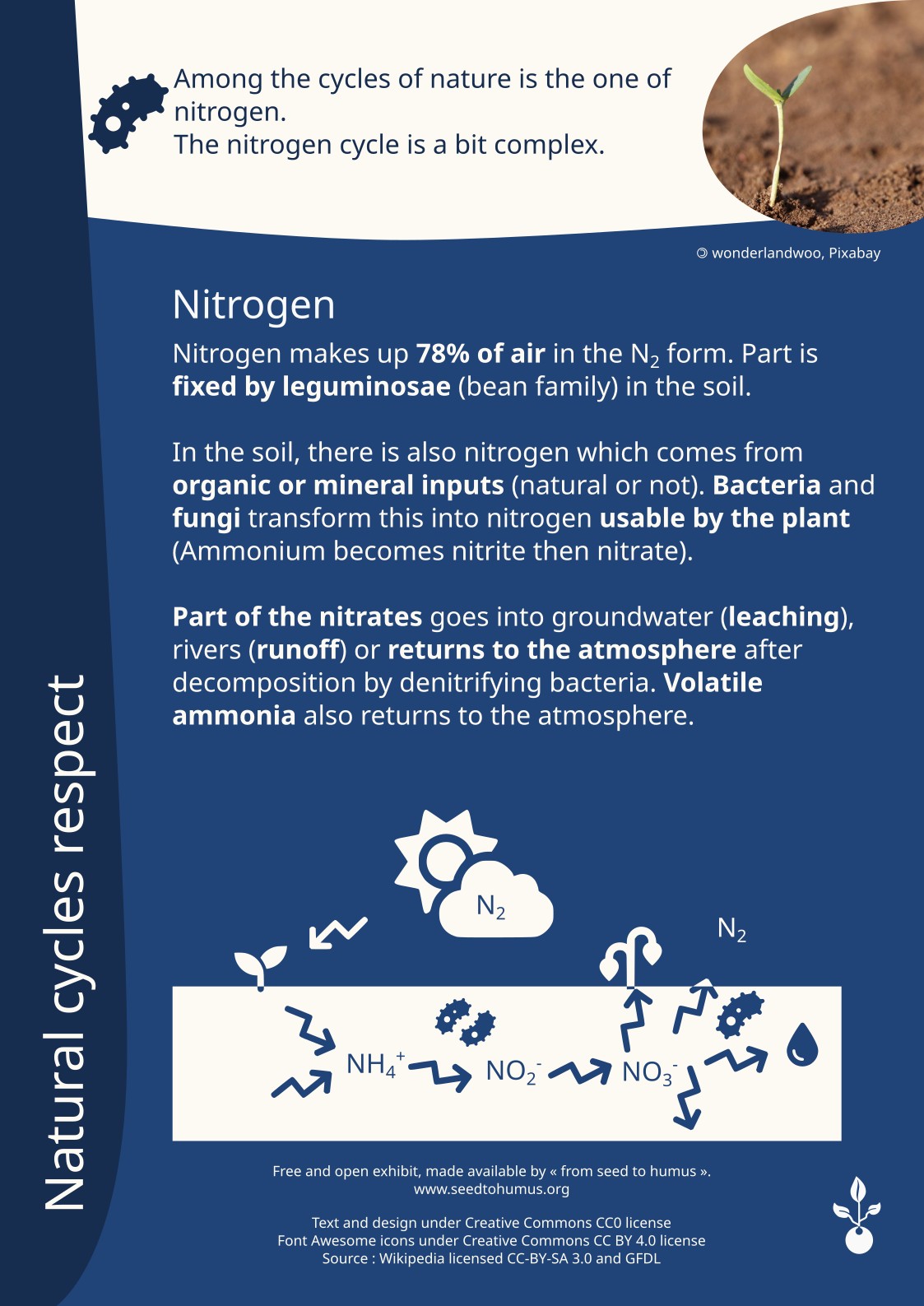
Furthermore, nitrogen and phosphate are real problems once they enter phreatic tables or rivers.(Eutrophication including green algae...) The soil lacks those elements which also become rarer. Would it not be a shame not being able to produce food and polluting with elements that we could otherwise use to produce food ? Here is a poster [3] about nitrogen and its cycle.
On top of the nutrients returning to the soil and the reconstruction of the ecosystems, we have to understand that managing urine differently means saving a bit more than 10 800 liters of water (2853 gallons) [4] per person per year. It matters as well for the summers getting hotter and hotter and water savings that will need to become more potent.
For people talking about hygiene, did you watch the videos showing particles ejected from water toilets ? [5]
Let us tackle the subject of resilience as well. France relies on importation for 95.1% of the minerals used as fertilizers [6]. Europe even suspended customs tariffs, as getting supplied in nitrogen (contained in urine) becomes increasingly difficult [7]. We have known for a time that natural phosphorus is disappearing and that we produce fertilizer with imported gases [8], meaning it is not the most durable resource, and we treat our organic waste as pollution instead of resources…
In a few words…
To put it simply, growing hedges, copses, bushes, trees and shrubs will help the ecosystem and help the soil hold itself. We then use prunings for the wood shavings and sawdust. It is useful for a local compost, regenerating the soil (clay-humus complex and the whole thing. [9]). It means we spend less on fertilizers, we use short channels, healthier fertilizers and have a stronger resilience.
Wikimedia Commons links
https://commons.wikimedia.org/wiki/File:Residual_Household_Waste_1.svg
https://commons.wikimedia.org/wiki/File:Residual_Household_Waste_2.svg
https://commons.wikimedia.org/wiki/File:Residual_Household_Waste_3.svg
https://commons.wikimedia.org/wiki/File:Exhibition_on_compost_6.svg


